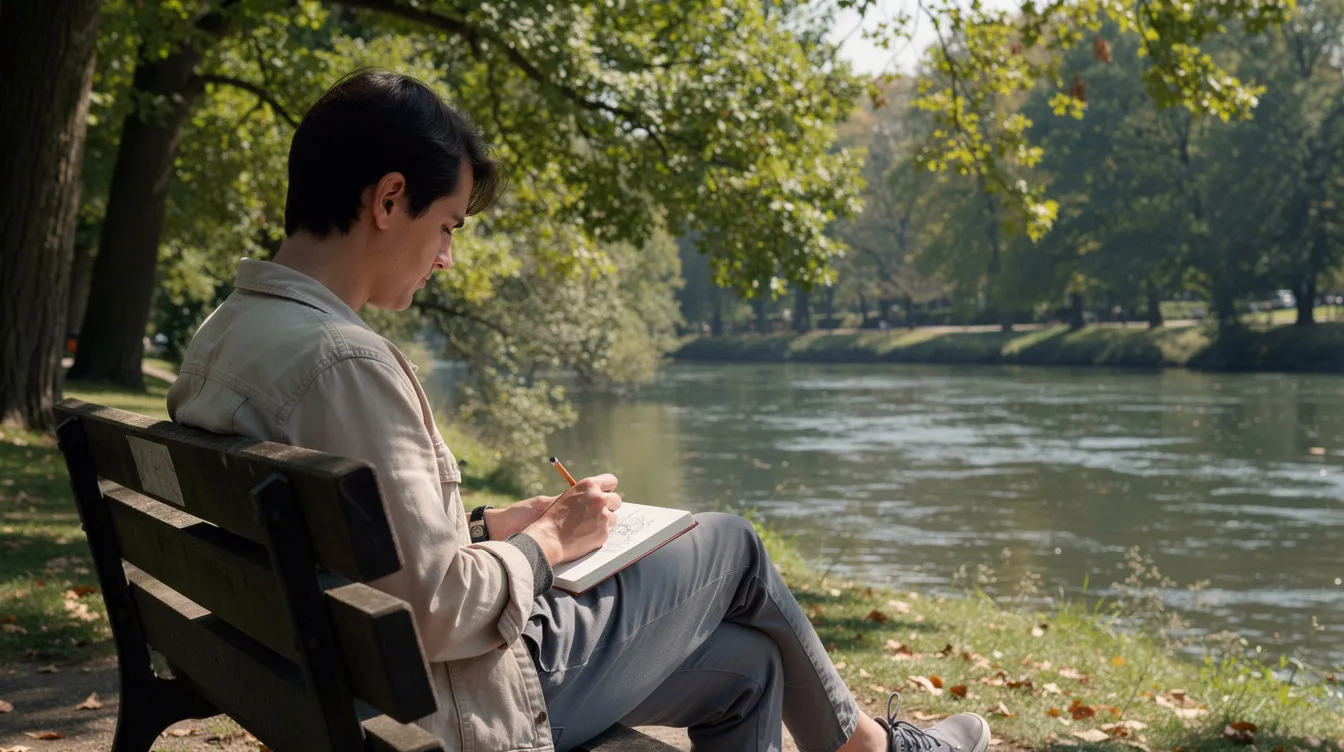
I draw at my kitchen bench in Hobart after the dishes are done. I started three winters ago with a borrowed pattern book and a pen from the library’s lost property box, and I kept going because I liked how a page of small, repeated marks felt to make. I get stuck all the time. This is the question readers email me about most, so I will answer it straight away.
Inspiration for Art: Why It Feels So Mysterious (and Why I Start Here)
Most people talk about inspiration for art as though it arrives like weather: sudden, dramatic, beyond your control. The muse descends or it does not. In practice, it is usually much quieter than that. Art inspiration often begins with noticing a small detail and starting anyway, even if all you have is a blank page, a cooling cup of tea, and one wobbly line.
What I have found, after three years of drawing most evenings, is that inspiration is not a lightning bolt but a process you can return to. It grows out of ordinary things: a walk to the shops, the colour of lichen on a fence post, an old sketchbook page, another artist’s work, a film, a pattern on the bench, a quick exercise when your mind feels stuck, even the way you collect and manage ideas for digital art. For people who want a calm, low-pressure drawing habit, those small sources matter more than waiting for a perfect idea.
There is a saying often attributed to Picasso: inspiration exists, but it has to find you working. Whether he actually said it is uncertain, but the idea matches my own experience exactly. For my first few months I sat with a blank page and waited for inspiration before starting, hoping a great idea would arrive on its own. Nothing came. The ideas only showed up after I had started drawing, after my hand was already moving. Inspiration begins to grow when you take immediate action, even if that action is just a single wobbly line.
This blog post is a calm, practical guide for beginners and busy people who want to find inspiration without turning art into another stressful task. If you often feel uninspired, pressured to make something good, or too tired to think of what to draw, the aim here is to help you build a simple, sustainable habit that makes drawing feel relaxing again. One evening last June I almost skipped drawing entirely. I was tired, the kitchen was still a mess, and I could not think of a single thing to draw. I picked up my pen anyway, drew the outline of the salt shaker, filled it with tiny triangles, and by the time the page was done I had three new ideas I wanted to try the next night. That is how inspiration usually works for me: it arrives after the beginning, not before.
Rethinking creativity: what inspiration really is (for everyday artists)
Last year at the Hobart library, I spent my lunch break feeling completely uninspired. I opened my sketchbook anyway and filled a page with leaf shapes, each one slightly different. By the end of the break I had a theme I returned to for weeks.
Creativity and inspiration are inherent to every human being. You do not need special talent. I think of inspiration as input and the creative process as output. Input is everything you absorb from the world. For example, that might be nature, books, music, history, other artists, or the texture of your morning toast. Output is what goes on the page. The more you feed the input, the more the output has to work with.
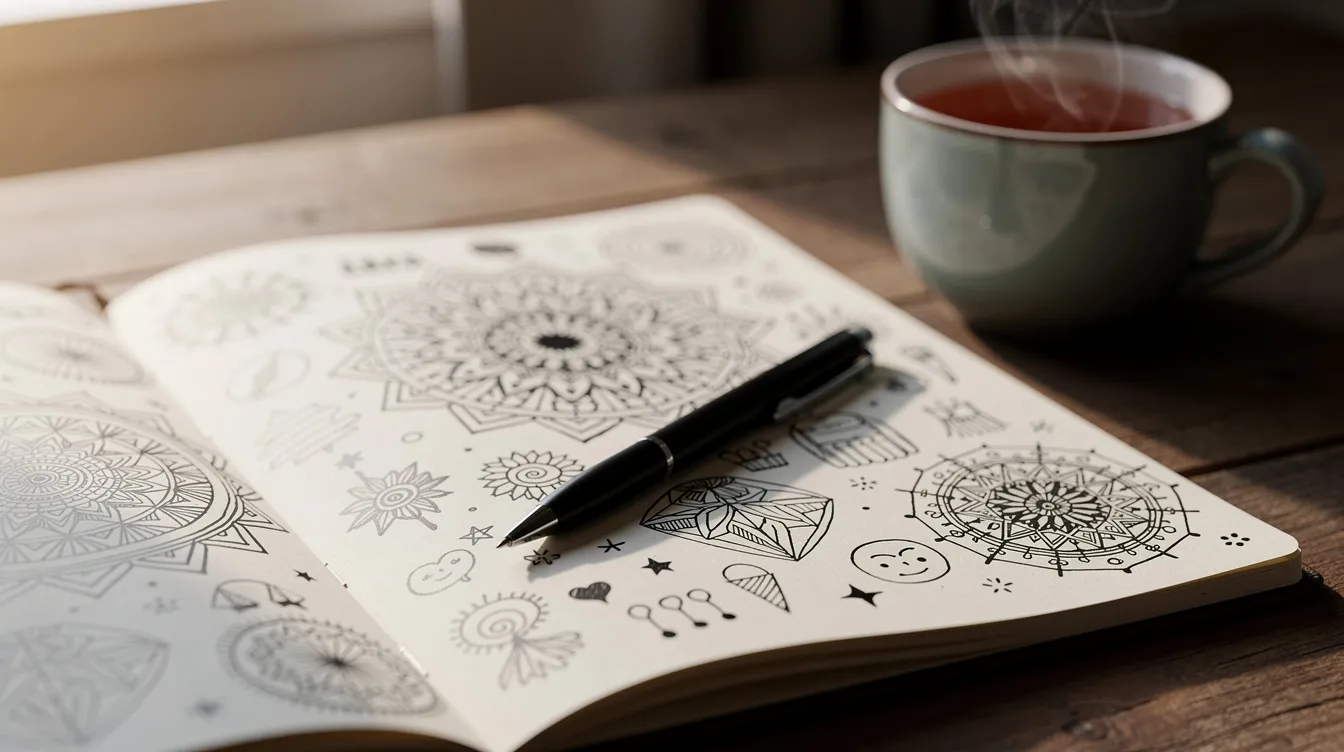
Everyone has a creative muscle, and simple repetitive drawing trains it. Mindful drawing serves as a low-pressure creative outlet for beginners because it asks so little. Inspiration often comes from mundane tasks and relaxation, including quiet moments of listening while you go about ordinary things, not from forcing yourself to produce a masterpiece. Try drawing the steam curls from a mug of tea as repeating spiral patterns. That is enough.
My strongest opinion on the matter: shrink the job until it is almost silly. A border around the page and nothing else. One matchbox-sized square filled with lines. The same leaf five times. Pattern work makes the next mark obvious, and that is why I love zentangles. If you want to begin pattern drawing, all you need is one pen and a few repeating shapes. Everyday objects can transform into extraordinary subjects for art when you look at them long enough. This is one small example of how simple exercises create ideas. If you are new to this, try starting with zentangles.
Finding inspiration in the real world: streets, buses, and the Tasmanian sky
One afternoon I walked along the Derwent River in late light and noticed how the shadow of a railing fell across the path in a repeating zigzag. That zigzag became a border pattern I still use. Artistic inspiration often comes from observing surroundings, and walking through cities can inspire new artistic ideas you would never discover sitting at home.
Observation is both conscious seeing and a creative act. Try noticing building shapes, cloud edges, gum leaves, shop window reflections, bus passengers’ shoes. Changing environments can spark creativity and motivation, so even a different route to the bus stop counts.
I keep a tiny A6 sketchbook in my bag and write three-word notes while waiting in line: “brick zigzag, teal” or “cable arc, thin.” Later, at the kitchen bench, I turn those notes into drawing prompts. A traffic light cable arc becomes a border tangle. A brick wall becomes a grid filled with patterns. Slow looking at one concrete object, like a single eucalyptus tree or the tiles outside the State Library, reveals more shapes and textures than I expect. That search for small details is what fills a sketchbook. If you want more ideas to start from, try these simple sketchbook prompts.
Nature as an endless sketchbook (even if you only reach the local park)
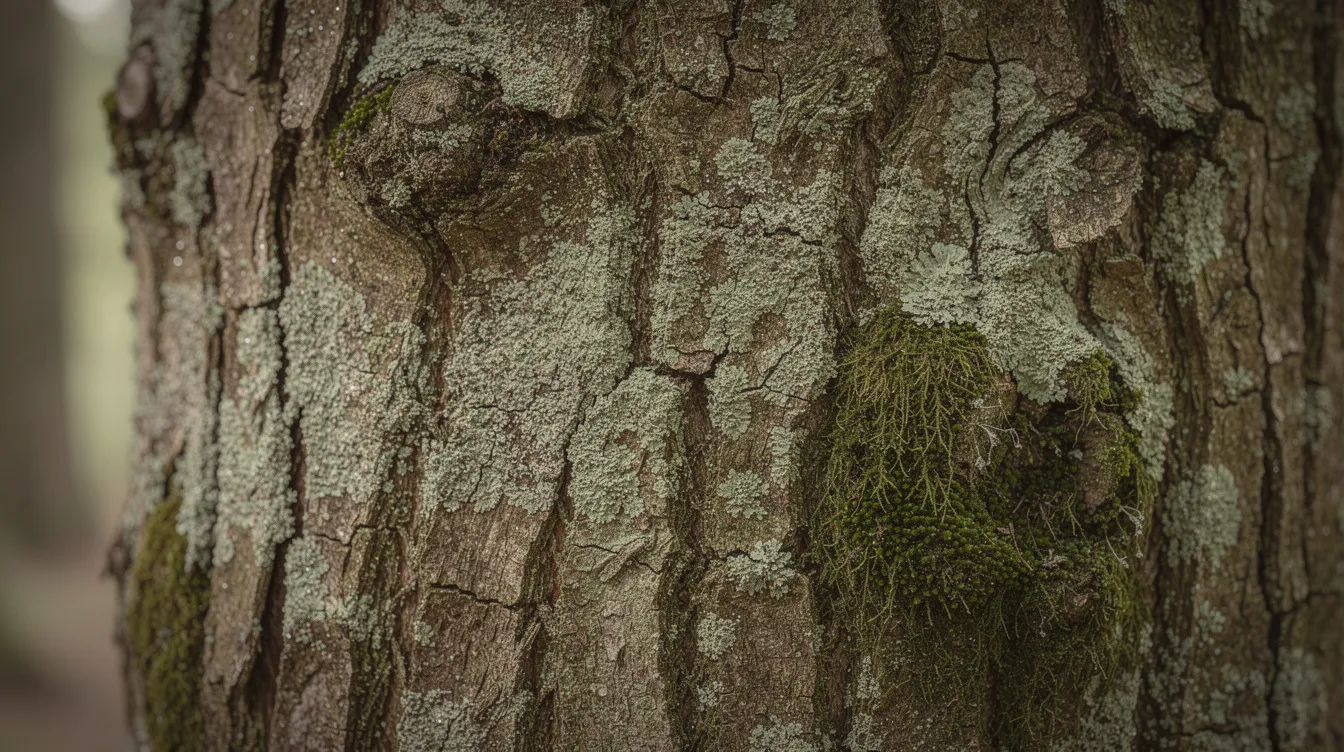
One autumn Sunday I walked up kunanyi, Mount Wellington, and spent most of the time staring at bark. The patterns on a single eucalyptus trunk gave me enough ideas for a week of drawing. Artists often find inspiration by exploring nature, and walking in nature can trigger new artistic ideas even on a short walk.
You do not need mountains. Balcony plants, a neighbour’s hydrangeas, weeds between pavement cracks: all of it works, and even small, local new experiences outdoors can refresh your perspective. A seed pod I picked up from the footpath last March has more going on than I can draw in one sitting. Natural landscapes provide inspiration through small textures and patterns, not just grand views of sweeping landscapes.
Here are a few mini-assignments I return to: fill a page with leaf outlines, trace the negative shapes between twigs, draw rock-like ovals shaded with one pen. None of these require skill or beauty. They ask you to pay attention to line, curve and slight variation instead of capturing a perfect plant.
You can use photography to collect details. Take photos of bark, lichen, petals, cracks, then translate those textures into pattern drawing in the evening. They can also spark painting ideas, not only pattern studies. The point is not to copy the photo but to let it remind your imagination what caught your eye.
Mining your own sketchbooks: past pages as future art inspiration
A few months ago I pulled an old sketchbook off a messy shelf and found a half-finished doodle from 2022. I had forgotten it completely. Something about the border pattern still felt alive, so I redrew it larger with a different pen, and it became one of my favourite pages this year. Seeing my own progress is oddly motivating, even when the old drawings make me wince.
Looking back over past work can spark new ideas, and reviewing old sketchbooks can reveal previous techniques you had forgotten you knew. Past experiences can influence current artistic practices in surprising ways. Artistic creativity often builds on previous works, and even a small collection of saved pages, tabs, or references from your own life can become a useful source for future artwork.
I set aside the first Sunday of each month to flip through old pages. I stick a coloured tab on anything that still interests me: a shape, a colour combination, a theme. Then I try a quick exercise, like revisiting my own craft through a 2020 doodle and redrawing it using only three colours, or enlarging one tiny border to fill a whole page. Reflecting on earlier works can enhance artistic growth because you see what you have already solved and what you still want to explore.
The key is to note what you enjoyed about an older page rather than critiquing it. That builds a curious, gentle relationship with your own art instead of a critical one.
Letting other artists and pop culture feed your visual library (without copying)
I carry a visual library in my head from years of reading graphic novels, watching Studio Ghibli films and browsing other artists’ sketchbooks. At the library I flip through old field guides, textile books and atlases during quiet afternoons, absorbing mood and composition without trying to memorise anything. Studying other artists’ work can inspire your own creations, and visiting art galleries can trigger inspiration for new works, even small local ones, especially when you spend time with the stories behind individual pieces.
Pop culture is a rich source of inspiration: 1990s album covers, cosy video game backgrounds, vintage postage stamps, old children’s book illustration. Exploring unexpected sources like old newspapers can lead to creative ideas too. Exploring historical artifacts can inspire contemporary artistic concepts, from medieval tile patterns to botanical plates, and art history is another tradition artists can learn from. Look for what genuinely delights you, not what you think you are supposed to like.
My safe study method: copy one small corner of a page, never the whole thing, in a private sketchbook. Focus on one element like palette or composition, then close the book and create an original piece from the mood alone. I love Islamic geometric patterns, the way circles, grids and repeating stars build complicated designs from one simple unit. I never copy the complex ones. I draw one small unit a dozen times and see what grid it wants. For a clear introduction, see the Wikipedia overview of Islamic geometric patterns.
Boundaries matter. Copying is practice and keeps its place in the sketchbook as study. Credit sources, which also helps the wider art community. Never present copies as original work. That keeps creative inspiration honest.
Simple exercises to spark ideas when you feel stuck
One winter week in July I did not want to draw at all. My brain was flat, so I used the stuff around me as raw material. Creative techniques can help overcome artistic blocks, and the tiny tricks I used that week are still the ones I reach for.
Blind contour drawing encourages freedom from perfectionism. Draw your mug without looking at the page. Fill a page with circles, each decorated differently. Try drawing to a favourite song and let audio-driven translation help you visualize the texture of sound in artwork. Drawing music scenes can be an engaging art challenge, and you discover interesting shapes when your hand follows rhythm instead of planning.
Use limitations to cut decision fatigue: one pen, only straight lines, the pen at the bottom of your bag, filling the page without lifting the pen, or one subject like keys or teacups. Limiting your colour palette can enhance creativity because fewer choices mean faster decisions. Using a new medium can challenge your usual creative process and wake up your hand.
Art challenges help when motivation has not appeared yet. They can include drawing original characters in various scenarios, and setting a time limit can boost creativity during those challenges. I prefer gentler versions: seven days of drawing plants on my windowsill, or a week of only straight lines.
My fifteen minute stuck-day routine: set a ten minute timer, pick one object within arm’s reach, draw a slow outline, add one pattern inside, then stop and date the page. If one part pleased me the next day, I redraw it larger. Changing your workspace can enhance artistic creativity too, so sometimes I move from the kitchen bench to the couch or even the front step.
If nothing works, I sharpen pencils, tidy the shelf, or walk and come back to draw one thing I noticed. Half pages and wobbly lines count. Movement matters more than masterpieces. If you want a slower way back in, I wrote about drawing as a meditative practice and how it helped me on the flat weeks.
Gentle digital inspiration: online art, without getting lost in scrolling
I enjoy looking at art online, but long scrolling on Pinterest or Instagram turns into comparing myself to everyone else and leaves me less inspired to make my own work. The wonder fades and the self-doubt grows.
I use a simple structure: set a timer of five to fifteen minutes, pick one image, draw only one part of it, a single flower or a border, then close the tab and go to paper. I keep themed folders on my phone, like “brick patterns,” “vintage lettering” or “shadow shapes,” and I favour saving material that leads to prompts over polished finished pieces.
For readers who want freely usable images, Wikimedia Commons has botanical plates, old textiles and architectural details. Use them as reference and credit sources. The goal is to feed your visual library without falling into the comparison trap, then let your imagination do the rest.
Building a small, sustainable habit so you can stay inspired
My routine is about twenty quiet minutes in the evening after the dishes, a cheap pen, a plain notebook and a cup of tea. That is my studio. The more you work, the more inspired you will feel, because your brain trusts that you will use the ideas it sends. I wrote more about building a daily drawing habit elsewhere on the blog.
Realistic starting points: three evenings a week, or one spread each weekend. Link drawing to existing routines. A quick page while pasta cooks. A pen kept by the kettle. On a daily basis, even five minutes counts.
Flat weeks happen. My fallback activity is repeating a familiar pattern, something my hand already knows, like a simple wave or a grid of dots. It keeps the habit alive without asking anything of my imagination.
Staying inspired is less about chasing motivation and more about creating a calm, regular space where inspiration is welcome. If you show up, inspiration learns where to find you.
Bringing it all together: your own quiet path to art inspiration
A brief recap of what we covered: everyday input, close observation of reality, nature, old sketchbooks, other artists, small exercises, careful screen time and gentle habits. Each one is a source of inspiration you can reach for on any given day.
Pick one action today. A five minute doodle of whatever is on your desk. A short walk to collect three patterns. Opening an old sketchbook to discover one shape that still feels alive. That is enough to start with.
Slow Line Studio is a personal, non-commercial hobby blog. Everything here is one person’s experience at the kitchen bench, not strict rules. I hope it helps, but your own path will look different from mine, and that is exactly the point.
Making art is allowed to be slow, imperfect and deeply your own. You do not need to dream up something exciting or figure out the future of your style before you begin. Inspiration grows best in kindness, in a quiet life where you pick up the pen and let your hand play.
FAQ
Where can I find inspiration for art if I have no ideas at all? Start with what is in front of you. Pick an everyday object, draw its outline, add a simple pattern inside, and let new ideas arrive once your hand is moving. A recent trip to the shops or a glance out the window is enough.
Is it okay to copy other artists when I am stuck? Copying a small part for practice is a normal way to learn. Different artists teach you different things. Keep it as study in your sketchbook, credit the source, and do not pass it off as original artwork.
How long should I spend on a stuck day? Ten to fifteen minutes is plenty. A timer lets you stop without feeling you quit early, and that short break from pressure often brings ideas back.
Do I need expensive supplies to find inspiration? No. I use a cheap pen and a plain notebook, and the supply that matters most is regular time. You do not need a fancy print or special paper to explore your creativity.
What if I look at other people’s art online and feel worse? Limit it. Short timer, one image, one small part to sketch, then close the tab. Save what sparks a fun idea and leave the rest. Your art does not need to look like anyone else’s.