Introduction: How Drawing Can Ease Anxiety Today
On a restless Tuesday in July 2023, I sat at my kitchen bench in Hobart with a pot of tea and a head full of noise. Work at the library had been long, the evening news was grim, and my chest felt tight in the way it does when anxious thoughts stack up without anywhere to go. I picked up a fineliner and drew slow scallops inside a small square, one row after another, for about fifteen minutes. Nothing in particular changed, but the phone went face down, my eyes had one small job, and the day’s loose ends stopped being the loudest thing in the room. Drawing helps create a quiet space inside during anxiety, at least for me.
I can’t tell you that drawing treats anxiety. My claim is smaller and more honest: when I draw slow, repetitive lines after the dishes, my evening gets a quiet shape. I started three winters ago with a borrowed pattern drawing book from the local library where I work part time, and a scratchy black fineliner from the lost property box. I kept going because I liked it, not because I was trying to fix anything.
I write Slow Line Studio as a hobbyist, not a therapist, so everything here is what has helped me alongside ideas readers can try at home. Think of this as a collection of practical drawing ideas, small rituals, art journal prompts, and gentle reminders about emotional expression and self kindness. If anxiety is a real struggle in your life, please also talk to a qualified professional.
Why Drawing Helps With Anxiety: What Research And Experience Suggest
Making art shifts attention from racing thoughts to the movement of your hand, the feel of pen on paper, and the shapes appearing in front of you. Drawing engages the visuospatial parts of the brain, pulling focus away from the verbal loops that feed worry. Repetitive motions, like filling a row of scallops or hatching parallel lines, activate the parasympathetic nervous system, the branch responsible for rest and recovery. Art activities can reduce anxiety symptoms through this shift alone.
A 2016 study at Drexel University measured cortisol in 39 adults before and after 45 minutes of art making. Cortisol levels dropped in 75 per cent of participants, and prior artistic abilities made no difference to the result. The participants used markers, clay modeling, collage, or free drawing, with no instructions. They reported feeling more relaxed and less caught up in unfinished tasks. Art-based regulation helps lower heart rate and reduce cortisol, a finding that has encouraged further research, though a large replication study is still needed.
Drawing allows expression of emotions without words. When worry is vague or hard to name, a few simple lines on paper can give it a shape you can look at instead of only feeling. Drawing can help develop mindfulness and self-awareness by making internal tension visible.
The psychological and psychophysiological benefits go beyond stress hormones. A 2026 review of 14 studies with 1,208 adults found that creating art reduced anxiety more than viewing art, with an effect size roughly twice as large. For adult women and men alike, making art appears to do something that passive engagement does not. Some researchers believe the creative process also raises dopamine levels through the small rewards of completing a mark, a line, a pattern, though direct measurement of dopamine during drawing is limited. One systematic review of art therapy for anxiety in adults found only three controlled trials (combined sample of about 162 people), so the evidence base is growing but still early.
Drawing For Anxiety Versus Formal Art Therapy
Art therapy is a mental health profession. A trained therapist guides sessions using art forms like painting, drawing, or clay modeling to help people process emotions, build emotional resilience, and decrease symptoms of anxiety disorders. Creative therapies in clinical settings are structured around treatment goals and may involve weeks or months of regular sessions. Art therapy can help improve mental health and reduce anxiety, and it is a low-risk way to cope with anxiety.
What I offer at Slow Line Studio is different: personal, non-clinical drawing ideas, sketchbook habits, and art exercises for self care. I am not qualified to diagnose or treat anything.
Try home drawing if you have restless evenings, busy thoughts before bed, mild social jitters, or just want a creative outlet that asks nothing of you.
Seek help if you experience constant dread, trouble functioning at work, panic attacks, thoughts of self harm, or anxiety causes that feel beyond your control. A GP, psychologist, or art therapist is the right first step. Both paths can work together; I think of drawing as a pleasant companion habit, not a replacement for therapy.
Getting Out Of Your Head: How Drawing Interrupts Worry Loops
Rumination is circling the same thoughts without reaching a conclusion. Anxiety drawing interrupts the loop by giving your attention somewhere specific to land. Engaging in visual creation shifts focus away from anxious thoughts and into the sensory details of making marks. Drawing can induce a meditative state when you let the pen lead and stop trying to solve the thought.
Mindful drawing can help regulate emotional responses and increase mindfulness. Mindful art invites you into a moment without judgment, similar to sitting meditation but with something for your hands to do. A flow state, that feeling of losing track of time inside a task, is consistently linked to lower stress in research. You do not need a studio for this. The kitchen table, the bus, or a lunch break all work. I once sat in the staff room at the library and drew tiny triangles in a grid for ten minutes after reading upsetting news, instead of continuing to scroll. My breathing slowed without me deciding to slow it.
Slow is the whole point. I try to draw each line at about half the speed that feels natural, and I notice the sound of the pen and where my hand rests on the page. When my mind wanders to tomorrow’s to-do list, which it always does, I return to the next line with no scolding. The aim of a drawing session like this is to feel calmer, not to produce a masterpiece. If the resulting artwork looks like a wobbly grid, that is fine. For a step-by-step approach to this, read my post on using drawing as meditation.
Simple Tools To Start: Pens, Paper, And Tiny Sketchbook Setups
You do not need expensive supplies. Doodling requires only a notepad and pencil, or a notepad and pen, to address anxiety. A biro and the back of an envelope count as making art.
My whole kitchen bench kit is a plain A5 sketchbook from a Hobart newsagent, two black fineliners (0.3 and 0.5), and a pencil. Pick tools you can replace without a pang, because if you are afraid of ruining the paper you will draw tight and nervous, the opposite of what you want. A small notepad in a coat pocket works for moments away from home.
Home basket: one cheap sketchbook, two pens, one pencil, kept where you sit. Out and about kit: an A6 notebook and one pen in your bag.
For paper, look for 80gsm or higher so ink does not bleed through. For pens, test a few on scrap paper at the newsagent and pick whichever feels smooth. Familiar stationery from work or school is perfectly good. The less precious the tools, the lower the pressure.
Mindful Line And Shape Exercises To Ease Anxiety
These are simple, repeatable art exercises for when you feel wired or stuck in your head. Mindful drawing involves creating patterns and shapes to encourage relaxation, and none of these require talent. Low-pressure drawing techniques can soothe anxiety because the focus is on rhythm and presence, not on producing something to frame. Drawing facilitates gentle engagement with emotions by slowing you down.
Start by drawing a border about the size of a playing card. A boundary makes the blank page less intimidating and gives a clear finish line.
Slow straight lines. Fill the border with vertical lines, drawn as slowly as you can, spaced about 3mm apart. Try five minutes. Notice the sound of the pen and let your breath settle. Repetitive patterns create a calming rhythm that builds as the page fills.
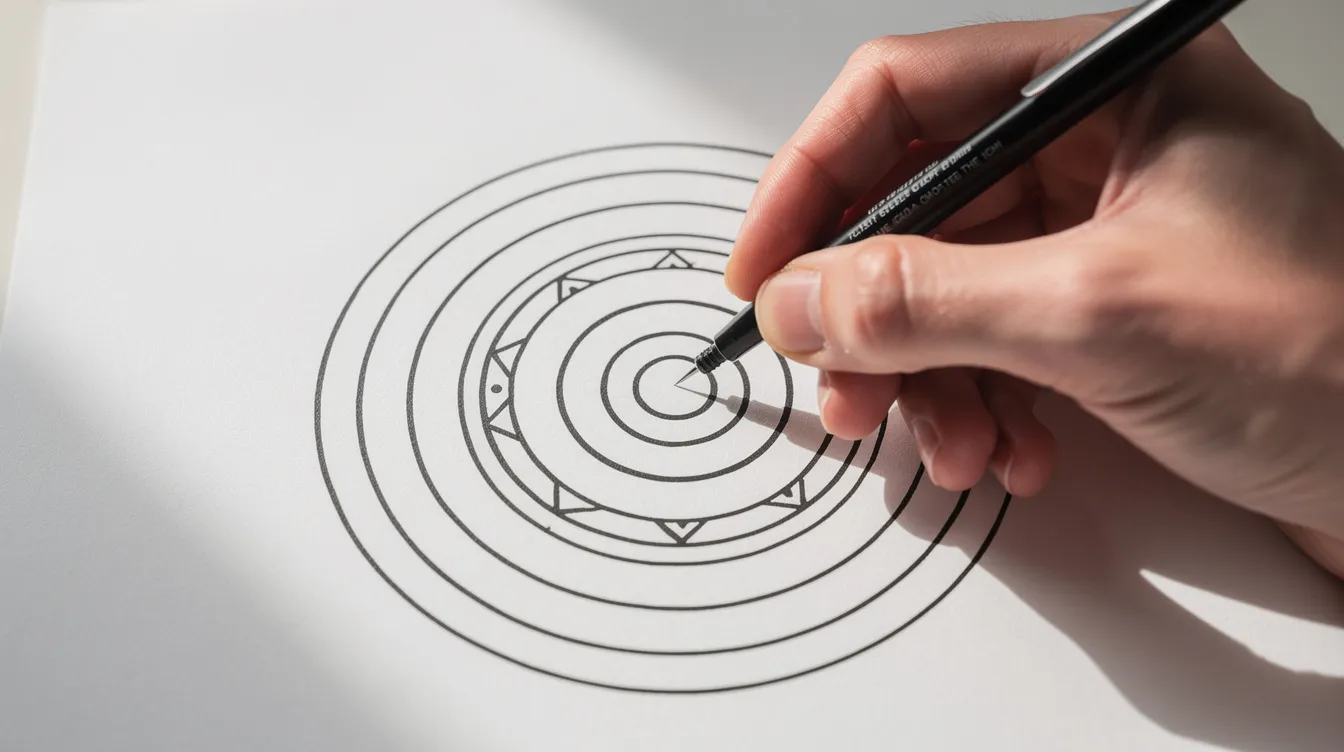
Nested circles. Draw a small circle in the centre, then draw another around it, and another, until you reach the border. Wobbles are expected. This drawing activity takes about five minutes and works well when thoughts feel jumbled.
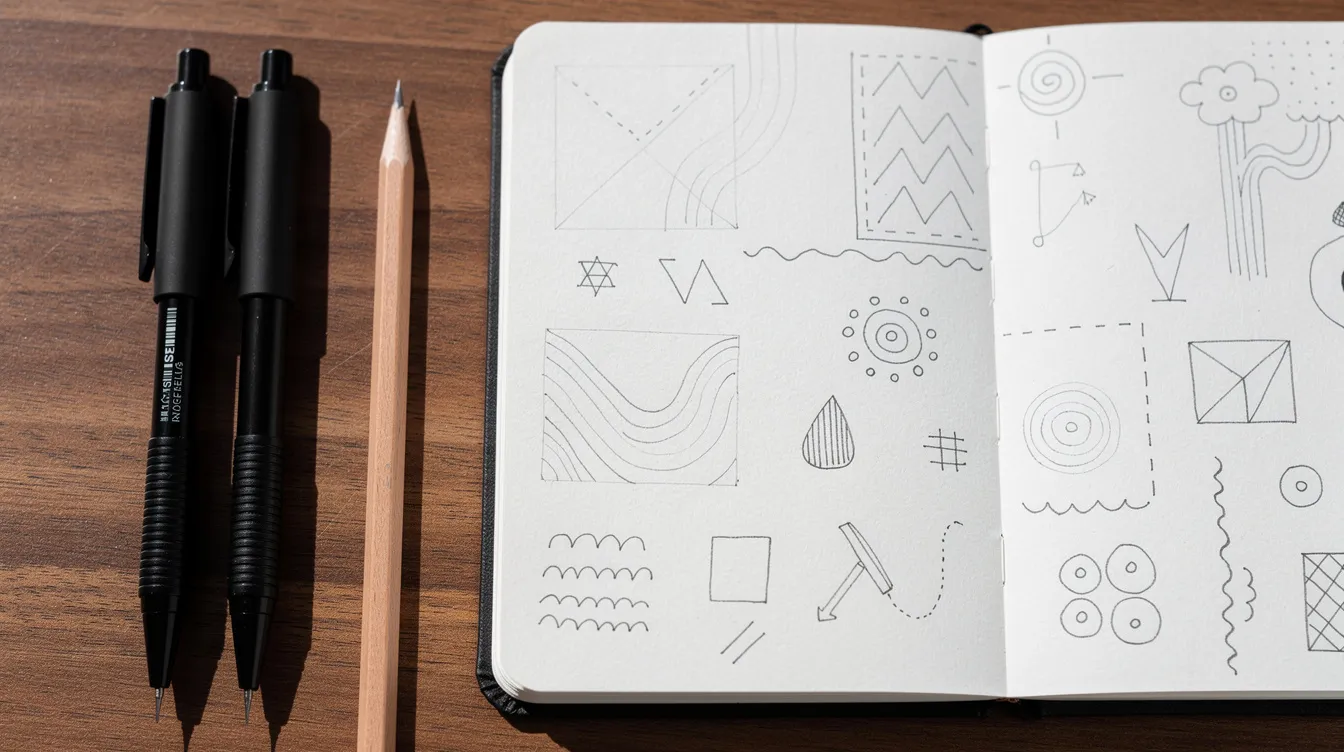
Tiny squares or grids. Draw a grid of small squares, then fill each with a different simple pattern: dots, diagonal lines, waves, crosses. This is free drawing with a frame, and it keeps your hands busy for as long as you want.
Loose waves. Draw a wavy line across the border, then draw another parallel to it, and another, letting the waves shift and overlap. This one feels closest to a meditative state for me.
Set a gentle timer or use a song length as a container so the practice feels finite. When blank-page dread hits, my fallbacks are a row of the same shape that grows each time, a spiral that expands until it hits the border, or the outline of a mug filled with stripes.
Breath And Drawing Together: A Simple Anxiety Drawing Ritual
Linking breath and drawing turns a creative activity into something closer to a body practice. When you breathe deeply and match the pace of your pen to your exhale, you give your nervous system two calming inputs at once. The idea is similar to BreathDoodles, which combines breathing with drawing for mindfulness.
Kitchen bench version. Sit with your sketchbook and pen. Inhale for four counts while drawing a slow upward line. Exhale for six counts while drawing a downward curve. Repeat, letting the lines form a gentle wave pattern across the page. Do this for five to ten minutes. If you notice you are holding your breath or speeding up, pause and start the next line at a slower pace.
Bus or lunch break version. In a small notepad, draw tiny leaf shapes, one per breath cycle: inhale for four counts and draw the left side of the leaf, exhale for four counts and draw the right side. This is quiet enough for public spaces and small enough to feel private. Scribbling and small repeated marks can provide a physical activity for channelling nervous energy, even in a cramped seat.
If you have a history of panic or breathing difficulties, stay within what feels safe. Forced breathing can be uncomfortable for some people; check with a health professional if you are unsure.
Mandala And Pattern Drawing: Repetition For A Calmer Mind
Pattern drawing is where I started. I divide a box into a few sections with simple lines, then fill each with one repeated shape: scallops, stripes, little circles, crosshatching, a row of leaves. I do not plan the whole thing. I pick the next line and make it. Drawing mandalas can enhance mindfulness and emotional regulation, and you do not need a compass or ruler. I wrote more about this style in my post on zentangles.
For a gentle introduction, try tracing a coin in the middle of the page, then adding slow, repeating rings of shapes while noticing your breath. Mandala coloring also helps regulate emotional responses and increases mindfulness, and adult coloring books are widely available in bookstores and online. Coloring requires no artistic skills and is accessible to everyone, making it a reasonable place to begin if drawing from scratch feels like too much. The question of coloring versus drawing comes up often; research suggests both reduce anxiety, and a 2016 finding showed coloring can reduce cortisol levels in 75 per cent of participants, just as other art making does. If you would like to make your own pages, I am a fan of Lisa’s teaching, especially the coloring page lessons at It’s Easy To Draw.
Drawing serves as an effective therapeutic tool for processing anxiety because the repetition quiets the verbal mind. A meta-analysis of 10 trials with 816 children aged 5 to 12 found that drawing and visual art interventions lowered anxiety in medical settings compared to usual care, with a large pooled effect size.
If a line wobbles or crosses where it shouldn’t, draw another beside it. Repetition covers a lot, and turning slips into features is the most freeing habit pattern work has given me.
Pattern ideas to try: scallop rows, checkerboards, concentric circles, parallel waves, tiny triangles, dot grids, leaf chains, zigzag borders.
Using An Art Journal For Emotional Expression
An art journal is any notebook where words, doodles, scribbles, and collage can live together without being shown to anyone. It supports emotional expression and mental well being by giving a private place to externalize fears, anger, and worries in colour and shape. Art journaling helps process emotions and regulate mood, and it promotes self-compassion even in small daily doses.
Three prompts I return to: “Today I feel like…” followed by a weather system drawn in pencil or pen. “Draw the shape of your worry in your chest,” using abstract imagery that allows difficult feelings to be externalized. And “Life without anxiety for one morning,” drawn as a small scene or a set of colours. Drawing helps externalize emotions, providing clarity and relief, and art journaling helps in recognizing patterns in emotions over time when you flip back through old pages. If you want more to try, I keep a list of simple sketchbook prompts.
Pages can mix writing, stamping, and drawing, and messy, unfinished pages are welcome. A gentle ritual: date a page, write one honest sentence about how you feel, then add lines or colours that match the mood. Artistic expression does not need to be polished to be useful.
Everyday Anxiety Drawing Habits: Tiny Practices That Fit Busy Lives
Ten minutes is plenty, and a small window means you cannot fail at it. Doodling can reduce anxiety levels, and it allows for emotional expression without judgment. Even a 2020 study with undergraduates found that 15 minutes of drawing after an anxiety induction lowered heart rate and state anxiety. You do not need a long evening.
Some micro-rituals to try:
-
A five-minute doodle with morning tea
-
One square of a grid filled while the kettle cools
-
Drawing your teacup or your toes after a late shift
-
Simple lines in a small notepad before bed
Tie the habit to something you already do. My bench has become a cue, and sitting there is half the habit. When I am tired I draw one border and one row of scallops, and that counts. Even 90 seconds of slow lines counts. Doodling can help ground you during moments of anxiety, and stopping at the timer teaches that the habit is small and kind, not something that eats your evening. Missing a day is not a failure. If you want more on building a daily drawing habit, I have written about that too.
After late shifts at the library, I sometimes draw the outline of my teacup and fill it with stripes. That helps me feel calmer before bed, and the drawing takes less time than brushing my teeth. Among the home remedies people try for restless evenings, this one asks the least of you. Creativity does not need a grand project. On the nights the blank page wins, I browse ways to find inspiration for a fresh starting point.
Making Space For Imperfection: Quieting The Inner Critic
The thought “I cannot draw” can increase anxiety and block the calming effects of a drawing activity. In the Drexel University study, about 25 per cent of participants did not show reduced cortisol; researchers noted that frustration and self-criticism may have played a role. When drawing becomes a performance, it stops being a creative outlet and starts being another source of pressure.
Try this: fill a page with deliberately wobbly circles or scribbly marks while repeating “There are no mistakes here, only marks.” The exercise is not about the resulting artwork. It is about making space for imperfection and letting go of the need to produce something good. Drawing as an art form is ancient and ordinary; doodling in margins is something people have done as long as there have been margins. If you are curious about the history, there is the reference entry on doodles.
I do not post most of my pages. Drawing for nobody is part of why it feels restful. Don’t grade your sessions. A “bad” page is still time spent on something quiet. Don’t chase a feeling either; some nights I feel calmer and some nights I simply feel like I drew a page, and both count. Emotional balance is not something you can force with a pen.
There are no mistakes in your anxiety drawing practice.
When Drawing Is Not Enough: Combining Art Making With Wider Support
Drawing can ease anxiety for many people, but it is not a cure for panic disorder, trauma, or persistent depression. Art therapy can help decrease anxiety and improve mental health when guided by a trained therapist, and it may be worth exploring if you feel anxious most days or if anxiety interferes with daily life. Risk factors for needing more support include constant dread, difficulty functioning at work, and thoughts of self harm.
If you notice these, consider speaking to a GP, counsellor, or psychologist. For Australian readers, Beyond Blue is a good place to begin. Drawing can still be part of the toolkit alongside therapy or medication, serving as a companion practice. Needing more help is normal and not a failure of your drawing practice. Creative activities and professional care are not in competition; they work on different levels and can sit side by side.
Closing Thoughts: Drawing As A Powerful Tool To Feel Calmer
Drawing for anxiety is about tiny, regular moments of art making that bring you back to your body and breath. Simple lines and shapes, breath-linked drawings, mandalas and patterns, and honest art journal pages are all ways to reduce stress and experience anxiety a little less loudly. Drawing can reduce a person’s state of anxiety, and it asks for nothing more than a pen, a moment, and a willingness to make a mark.
One small action today: draw slow lines for three minutes after you finish reading. I will likely be at my kitchen bench tonight too, with a fineliner and whatever shape comes. You are welcome to join in spirit with your own pen and page.
FAQ
Can drawing cure anxiety?
I cannot say that, and I would be wary of anyone who does. I am a hobbyist, not a health professional. Slow, simple drawing is a calm part of my own evenings. If anxiety is a real struggle, speak to a doctor or a support service. What the research offers are valuable insights into how art making lowers cortisol and state anxiety in controlled settings, but that is different from a cure.
Do I need to be good at drawing?
No. In the Drexel University study, prior artistic abilities had no effect on whether cortisol dropped. Pattern work and doodling are about repeating simple lines, not realism or talent. You can start today with scallops and stripes and no experience at all.
What materials do I need?
A cheap notebook and a black pen are enough. I began with a pen from a lost property box and still mostly use inexpensive fineliners and a plain sketchbook. Doodling requires only a small notepad and a pencil or pen.
How long should I draw each day?
Ten minutes is a good start. Research uses sessions of 15 to 45 minutes, but even shorter windows help. A short, fixed window is easy to keep, and you can keep going if you feel like it. Missing a day is not a failure; pick the pen up again the next evening.
What if my mind keeps wandering while I draw?
Mine does too. When you notice, return to the next line. There is nothing to fix. The returning is part of the habit, the same way it is in meditation. Over time you may find the wandering gets shorter, but even if it does not, you still spent those minutes on something quieter than scrolling.