
I doodle in staff meetings at the Hobart library, on the back of shopping lists, and along the margins of training handouts. A few lines and geometric shapes appear under my pen whenever I need to unwind. For a long time I thought this was just fidgeting with ink.
Quick answer: what is doodling and why it matters
Yes, doodling is real practice, as long as it is mark making with a bit of attention rather than truly idle scribbling. Doodling is often seen as a form of spontaneous drawing, creating random drawings without a specific purpose, and that looseness is exactly what makes it useful. I started three winters ago with a borrowed pattern drawing book and a pen from the library’s lost property box. I never meant to practise anything, and my hands still got better. My lines grew steadier, my spacing more even, my confidence with a pen noticeably calmer.
This article is for adults and teens who want a calm, low-pressure art habit. The three benefits I keep coming back to are stress relief, playful creativity, and a gentle way to build drawing confidence without “real art” pressure.
What is doodling, really?
When I flipped through my 2023 pocket diary, I found the margins full of tiny stars, cups of tea, looping patterns and scribbles I never meant to “draw.” That is doodling. The word doodle means “scribble” or “little drawing,” and it fits: doodling is drawing that values the act over the outcome. It happens on the phone, in Zoom meetings or while waiting for pasta water to boil. Doodling can occur while the mind is occupied with other tasks, which is what separates it from formal drawing. Where observational drawing uses careful looking and measurement, doodling is loose, unplanned, built from repeated simple lines and shapes rather than studied proportion. The Wikipedia entry on doodles traces the word and its history if you like that sort of thing.
Doodling allows for unfiltered self-expression and exploration of ideas. It also shows up everywhere: bullet journals, meeting agendas, library checkout slips, envelopes, bus tickets, cafe napkins.
I want to be honest about the limits. Pure pattern doodling does little for proportion, perspective, light and form, or drawing from observation. Doodling gets the hand ready, but looking is a separate practice. And not every rough drawing needs to become something more. Many doodles are meant to stay rough or be thrown away. That is part of their freedom.
Why I doodle: focus, feelings and a bit of science
During a two-hour training session at the library in May 2024, I filled the back of the handout with dots, circles and little bricks. I stayed awake, and I actually remembered the key points afterward. That lines up with research: doodling improves memory retention during lectures or meetings by keeping part of the brain gently occupied. One well-known study found doodlers recalled 29 percent more detail from a dull recording than non-doodlers. The idea is that doodling engages just enough attention to prevent the mind from drifting completely, which can help organize thoughts and improve concentration.
Doodling is a powerful cognitive tool for creativity and stress relief. It activates the Default Mode Network in the brain, the same network involved in daydreaming and creative thought, and it has been shown to improve problem-solving abilities. Doodling encourages divergent thinking and creative confidence. Using visual anchors in doodling can enhance memory categorization, and sketch-noting, which combines drawing and visual elements, is an effective form of note-taking that can transform notes through visual summaries and diagrams.
That said, the science is not perfectly tidy. A large 2024 study found that traditional note-taking still outperformed doodling for information retention during lectures. Different doodling styles serve distinct cognitive functions, and structured doodling (filling shapes, following patterns) tends to give better cognitive results than totally freeform scribbles. The emotional side, though, is consistent. Simple doodling can reduce feelings of anxiety, and engaging in art-making activities, even basic doodling, activates relaxation responses in the body. Engaging in doodling lowers stress hormone levels. Repeating abstract shapes or simple lines can feel like counting beads or knitting, steadying racing thoughts and helping reduce stress.
I doodle during long phone calls, while listening to audiobooks on the bus in Hobart, and in a diary after a stressful workday when negative thoughts are circling.
What slow doodling quietly trains surprised me. Line control came first: my lines wobbled when I rushed and went flat when I pressed too hard. Then spacing and rhythm, which carry over to drawing leaves, bricks and fences. And the habit of finishing a small piece in ten minutes, which taught me that practice does not need to be grand.
I am not a therapist, just a hobbyist sharing my experience. Treat doodling as a personal calming tool rather than formal therapy.
What you actually need to start doodling
Doodling can begin with the biro in your kitchen drawer and the corner of today’s shopping receipt. Here is what I really use:
-
A 0.5 mm gel pen
-
A cheap ballpoint
-
An A5 spiral notebook from a Hobart newsagent
-
A soft pencil for lighter marks
My favourite is still a cheap fineliner, because a precious pen makes you afraid of it and fear shows in the line. Optional extras for those who enjoy them: a small fineliner set with different thicknesses, a brush pen for thicker strokes, and a few coloured pencils or markers. No special doodle art brands are needed, and I would rather you start tonight with what you have than wait for better materials.
Smooth paper suits repeated geometric shapes and fine patterns. Scrap paper is perfect for carefree, throwaway doodles where mistakes do not matter.
How to begin: from a few lines to a filled page
You do not need to plan what you will draw before you start. Move your pen and see what appears. Before I begin I name one small thing to work on, such as even spacing, smooth curves or a clean edge where two patterns meet.
A starting exercise: draw a few lines across the page, add smaller lines branching off them, and let them become twigs, rivers or abstract shapes. Doodling enhances creativity and idea generation when you stop worrying about the result.
For a shapes exercise, fill a page with circles, triangles and a rectangle or two, then add dots, stripes and tiny patterns inside each shape. You can grow a doodle from one seed shape, such as a spiral that turns into waves, petals or radiating lines. Try drawing a coaster-sized boundary first, so the doodle has a job and feels finished when it is full. Draw each line a little slower than feels natural so mistakes show while they are small.
For readers who find a blank page too much, Zentangle involves structured patterns within a defined space, giving a step-by-step, rule-based route in. Having a simple structure is what stopped me abandoning pages halfway. If that sounds like you, I wrote up how to start drawing zentangles.
If you make an unintended blob, turn it into a stone, leaf, cloud or shadow instead of starting again. Forget perfection. The process matters more.
Popular doodle art styles to explore
There is no single correct way to doodle. From quiet abstract shapes to playful cartoon characters, all count. Lettering is a type of doodling too, involving decorative text styles and different fonts. Abstract doodling allows for spontaneous and free-flowing designs. These are loose categories to mix freely or ignore.
Notice which marks you naturally make in meeting margins. That is a clue to your preferred style.
Pattern, geometric shapes, and abstract shape doodling
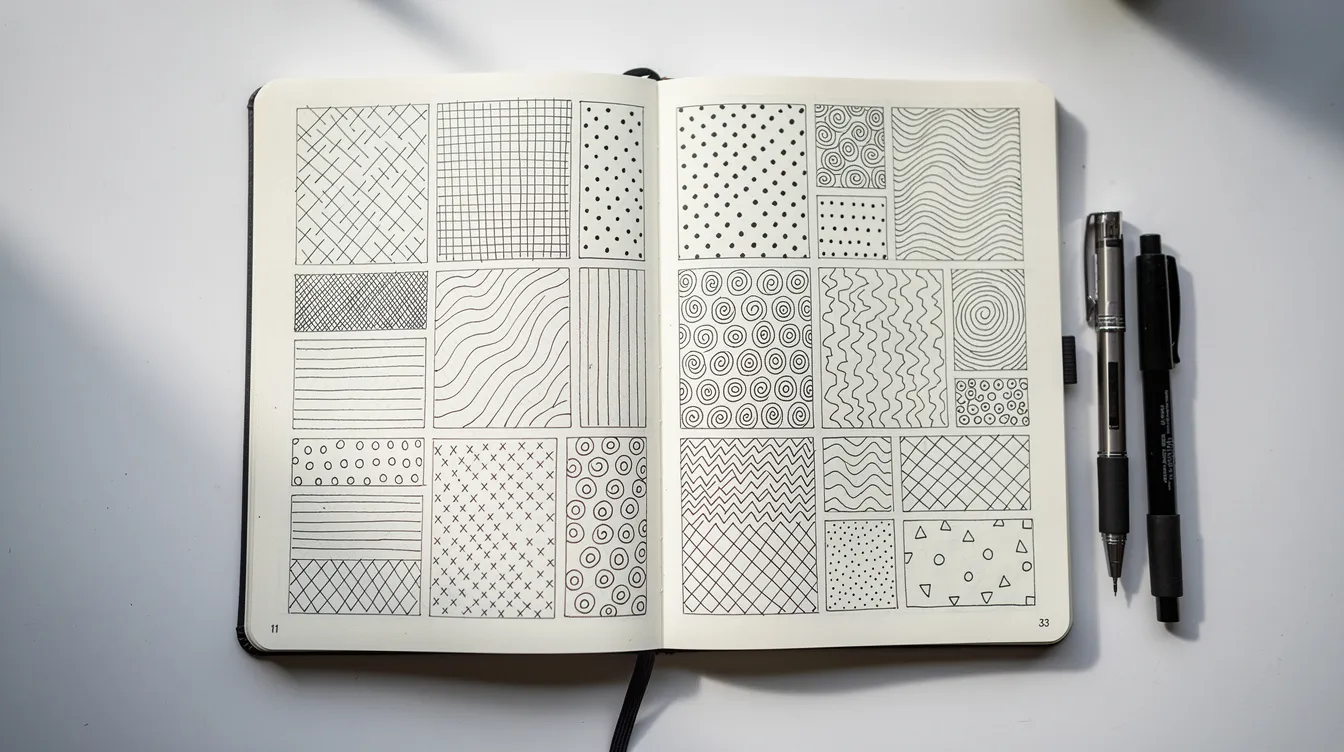
Repeated simple lines, dots and curves create fields of pattern that slowly spread across a page. Combining geometric shapes with freeform curves makes intricate designs: checkerboards beside pebble clusters, wavy bands next to tight grids. Hatching and cross-hatching use the same moves as real shading (parallel lines, layered directions, tighter or looser spacing), so pattern work carries over to more complex compositions.
Exercises I keep returning to: ruler-free parallel lines in a box (mine got noticeably straighter in a couple of weeks), a border that grows around the page edge and teaches spacing when it fails to meet at the corner, and one shape with ten different fillings, which became a vocabulary of marks I could borrow for real objects. Work slowly and notice the pen moving, treating patterns as a mindful exercise rather than a puzzle to finish.
Simple mandala-style circles
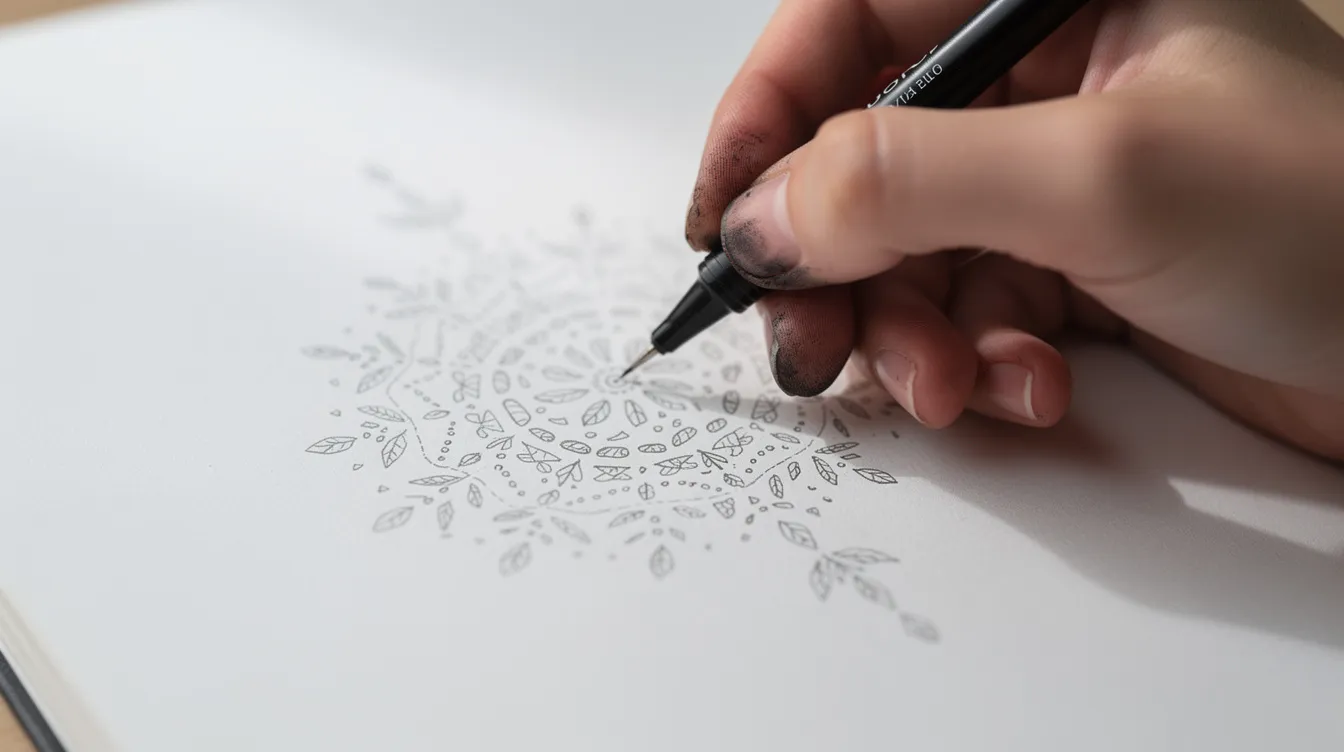
Formal mandala traditions are rich and cultural. Here I mean relaxed, home-made circle doodles inspired by that radial idea. Mandala doodling features radial symmetry and geometric shapes. Start with a small circle in the centre, then add ring after ring of triangles, scallops and dots. Use a mug or jar as a circle guide if freehand circles feel stressful. These are wonderfully soothing drawn slowly in the evening with a cup of tea nearby. The act of doodling can help you sit with emotions while staying in the moment.
Tiny everyday objects and icons
My sketchbooks are full of tiny Tasmanian objects: gum leaves, boots, mugs, little books, clouds over kunanyi / Mount Wellington, flowers from the garden, landscapes sketched in a few strokes. Build quick icons from basic shapes: a book from a rectangle and a few lines, a cup from an oval and a U-shaped curve. Try themed rows such as “things on my desk” or “weather this week” to discover new ideas and find inspiration.
My bridge back to drawing from life: ten minutes of doodling to loosen my hand, then one real object on the bench, a cup, a pear, a key, to measure against. Add details slowly. This is where doodling becomes observation practice and the two worlds meet.
Playful faces, plants and creatures
Simple faces start from a circle, two dots for eyes and one line for a mouth, then hair or glasses for more detail. Easy plants: a curved stem with paired leaves or petals, a pot made from basic shapes. Cartooning doodles can help develop character drawing skills. Try a blob with legs and a friendly eye, a whimsical creature that needs no anatomy. Wobbliness gives these doodles charm. Stick figures stand on their own as art. Doodling serves anyone who insists they “cannot draw people.”
Doodling as a mindful daily habit
At about 9 pm, after the dishes, I sit at the kitchen bench in Hobart and draw quiet patterns for ten minutes before bed instead of scrolling my phone. Doodling can serve as a form of meditation. Mindfulness during doodling can improve relaxation and focus.
Simple routines help: one small doodle while the kettle boils, or one filled 5 cm square each evening. A tiny 5 to 10 minute time box beats the occasional two-hour session. Keeping the pen and a small sketchbook on the bench means no setup. Doodling reduces stress and anxiety levels and improves concentration during tasks, even when those tasks are just winding down for bed.
Notice sounds, breathing and pen pressure while you draw. Fit doodles into existing habits, like a strip of pattern under each day in a bullet journal or around weekly to-do lists. The feelings of calm come quickly. Experiment with colors or keep it monochrome, whatever feels like fun.
Keep every page in one sketchbook, in order. Comparing the shaky, cramped first month with the calmer, more even third month is the most convincing evidence that doodling is practice. I never felt myself improving day to day. The sketchbook showed me. If you want more on this, I wrote about building a daily drawing habit.
When doodles grow: using them in larger art and journals
Doodling can stay casual or gently grow into more intentional art if that feels appealing. I have turned a page of abstract shapes into a coloured piece and stitched patterns into a border around a written entry. You can use sketches to decorate hand-written letters, bookmarks, homemade cards or cheap notebook covers. Let some pages stay on scrap paper so nothing feels precious. Explore different styles and express whatever your imagination offers.
My honest verdict: doodling is the warm-up and the daily scales, and observation drawing is the actual pieces. Do both, keep it cheap, keep it slow. Represent the world on paper in your own way. Create more ideas than you use. That is how the body of work grows.
A page of small, imperfect doodles from this month may be the sketchbook spread that makes you smile most in five years. Happy doodling.
FAQ
Is doodling the same as drawing?
Not exactly, but they overlap a lot. Doodling is looser and less planned, while drawing usually aims at a subject with more detail and structure. The marks, the pen skills and the meaning you find in both are the same. Think of doodling as the informal end of a wide spectrum.
Will doodling make me better at drawing realistic things?
It helps line control and confidence, but realism also needs observing and measuring real form. Pair your doodling with a few minutes of drawing real objects each week. The two techniques support each other.
How long should I doodle each day?
Ten to fifteen minutes is plenty. Short and regular beats long and rare, and it fits around the dishes. Some examples from my own habit: one filled square before bed, or a border while the kettle boils.
What pen and paper do I need?
Any fineliner or ballpoint and a sketchbook with reasonably smooth paper. My own set is cheap. You do not need to explain a big purchase to anyone.
Should I doodle from memory or from a reference?
Both. Memory and pattern doodles build hand skill and invention. References train the eye. I alternate within the same week and sometimes within the same session.