
A few years ago a library patron in Hobart returned a book on pattern drawing with a pen tucked inside the cover. Nobody claimed either, so I took both home. That night at the kitchen bench I opened the book, copied a handful of patterns onto a scrap of paper and kept going until my tea went cold. I was not trying to learn an art style or build a skill. I just liked the quiet feeling of filling a small page with repeated marks.
1 | What are Zentangles and Zentangle art?
Zentangles are a structured drawing method that builds beautiful abstract images from repeated patterns, or tangles, on small square tiles. The trademarked Zentangle method was created by Maria Thomas and Rick Roberts in the early 2000s, while “zentangle art” is often used more loosely by hobbyists for pattern-based drawing inspired by the same idea. On Slow Line Studio I follow the spirit of the practice but I do not teach the official program.
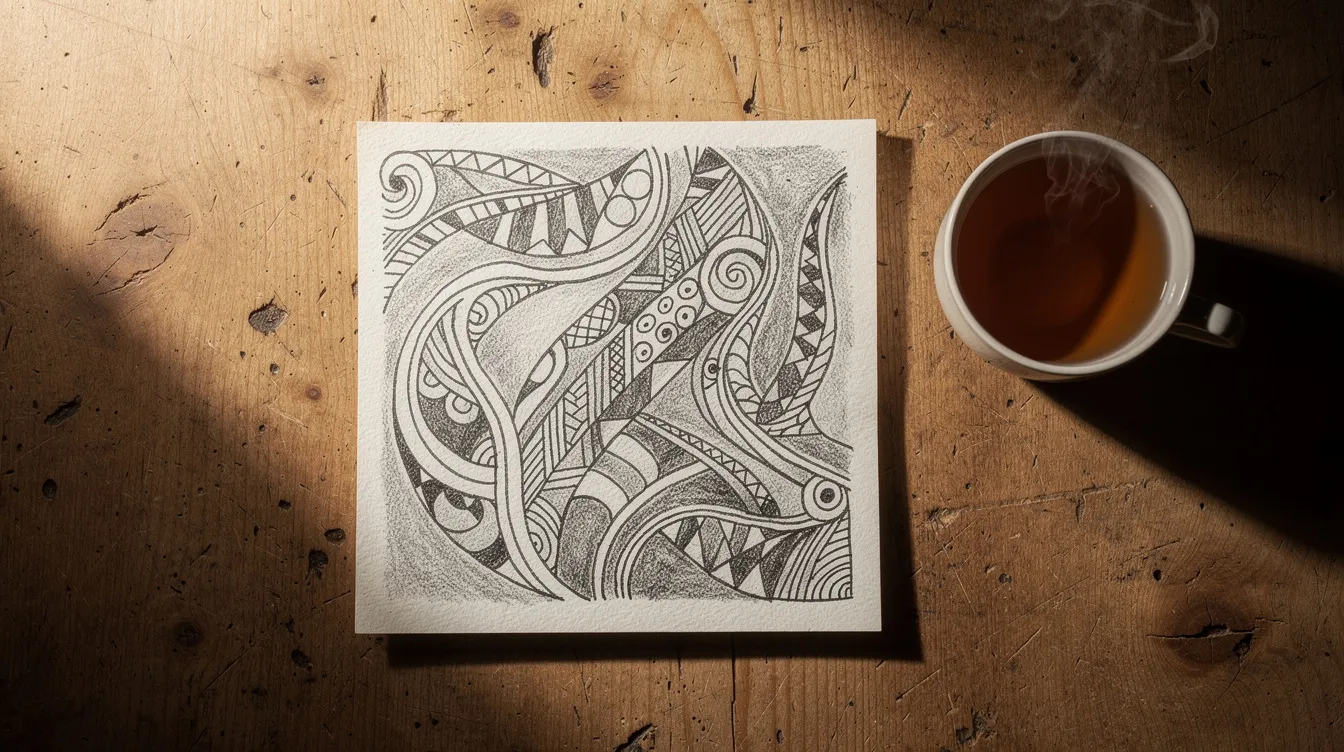
The patterns themselves are called tangles, and each one is built from simple strokes: dots, straight lines, curves, S-shapes and orbs. A traditional Zentangle is created on a 3.5-inch square tile of creamy paper. You draw a faint pencil border, add a pencil string that divides the space into sections, fill each section with black ink tangles, then add soft pencil shading for depth. The finished product is a small, intricate square of abstract pattern rather than a picture of a flower, animal or other real object. You draw one tangle, then another beside it, and the tile fills up from many small decisions. That simple act is the whole point.
If you want a calm, low-pressure creative habit, this beginner’s guide is for you, especially if you think you can’t draw or only have ten quiet minutes to spare. It walks through where Zentangle came from, how it differs from doodling, why many people use it to relax and focus, what materials you need, how to make your first tile step by step, and where to find more patterns once you want to keep going.

2 | How the Zentangle method began and the principles behind it
The Zentangle Method grew out of a moment in fall 2003 when Maria Thomas was decorating an illuminated letter with repetitive patterns and Rick Roberts, experienced in meditation, noticed she had entered a deep flow state. They developed a practice they could teach to others, and the first public classes began around 2004. Zentangle is a registered trademark of their company, Zentangle, Inc.
The principles are gentle. The philosophical foundation is that anything is possible, one stroke at a time. There are no mistakes, no eraser, and the process matters more than any finished product. A traditional tile sequence starts with a moment of gratitude, then a pencil border and string, then ink tangles drawn one section at a time, then pencil shading, and finally a pause of appreciation. There is no correct orientation, so you rotate the tile freely as you work. The method emphasizes creating art as both a meditative practice and an art style built around simple, repeatable patterns.
I learned all of this from a library book, not a class. In practice my pencil guide marks are faint enough that I rarely reach for an eraser. If you can make a straight line and a curved one, you can do this in a creative way that stays low-pressure. A Certified Zentangle Teacher is someone who has completed official training with Zentangle, Inc. I am not one, just a keen hobbyist sharing what I have picked up over three winters of drawing structured patterns at my kitchen bench.
3 | Zentangle vs doodling and “zentangle-inspired” drawing
After the dishes most evenings I sit down with a pen and whatever paper is handy. For a long time I was doodling, scribbling shapes while half watching the news. Slowly those loose marks shifted into something more intentional as I began repeating named zentangle patterns with real attention. I think of a zentangle as a doodle with a bit more shape to it, and I treat the two as neighbours rather than rivals. For background on the origins of the habit, see Wikipedia’s page on doodles.
At first glance, Zentangle and doodling can look similar, but the difference is mainly one of structure. Doodling is often done while distracted or multitasking, with no plan and no particular form. A zentangle uses a defined tile, a string and named tangles drawn on purpose. There are no mistakes in Zentangle; unexpected marks can be integrated into the design, which is a more generous attitude than most doodling allows. If you want to dig further into doodling as drawing practice, I have written about that separately.
Zentangle-inspired art, sometimes shortened to ZIA, is anything that borrows the patterns or mindset without following the classic small black-and-white tile. You might wrap tangles around a bird silhouette, fill a journal page with spirals and geometric grids, or draw mandala-like circles packed with repetitive patterns. For kids, beginners and anyone exploring creativity in different ways, mixing methods is absolutely fine. Loose doodles become more mindful once you start repeating a small set of zentangle patterns with attention, and that shift is worth noticing.
4 | Why try a mindful Zentangle art practice?
Why should you try this? Because zentangle art reduces stress and promotes relaxation, and because it fits into the smallest gap in a busy day. Drawing repetitive patterns is relaxing and calms the mind and heart rate. Using repeating patterns helps to engage the brain in a calming, focused state, much like slow breathing or knitting rows. The rhythm of repeated lines is the thing that hooks you.
Mindful drawing can improve focus and concentration. Zentangle encourages mindfulness similar to meditation, and mindful repetition in the drawing process quiets the inner critic and encourages flow states. Zentangle promotes relaxation by allowing individuals to focus on the present moment rather than worrying about the beauty of the result.
For me the border and string mean I never face a blank page wondering what to draw, and that alone has kept me coming back. A tile is small enough that a bad one costs nothing. The lopsided ones in my shoebox are often the ones I like most later. Most nights I manage one tile at the kitchen bench before I stop, and on a quiet half hour at the public library where I work part time I sometimes finish two. Zentangle can be a part of a daily routine to promote mindfulness and relaxation, and a way to find calm when life feels busy or overwhelming. My short version of building a habit is to keep the tools out on the bench and keep each session small. If you want more on building a daily drawing habit, that is a good next read.
Zentangle art is accessible to all skill levels, and it feels especially kind to self-described non-artists because the patterns rely on simple marks. I should say clearly that this is not therapy or a replacement for mental health care, just a low-pressure hobby that many people, me included, find soothing.
5 | Materials you need for Zentangle-style drawing
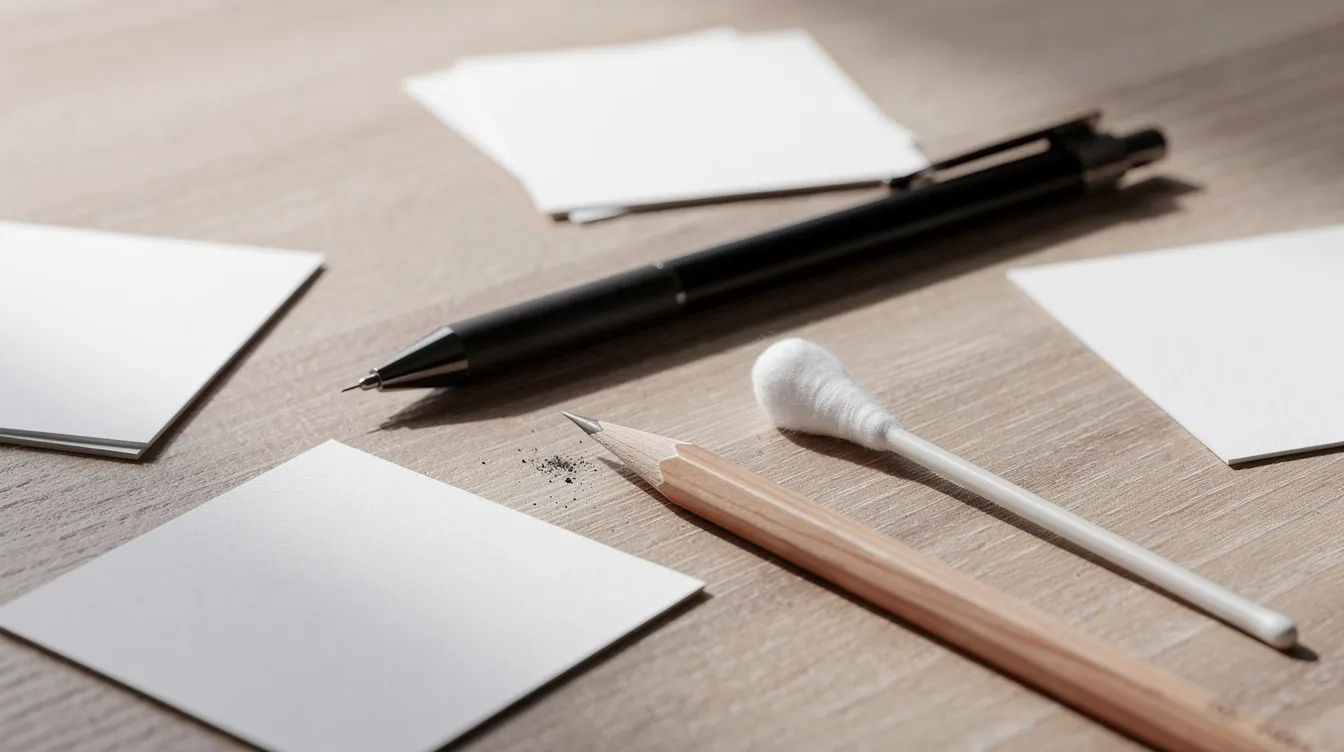
You can begin with whatever pen and paper you already have. A fine-tip pen is essential for drawing tangles, and a pencil is used for sketching the string and shading. Beyond that, very little is needed.
The traditional setup is a 3.5-inch square tile of high-quality cotton paper, a soft graphite pencil and a black fine-tip pen in a size like 01 or 03. Precision Black Micro-Pen Fineliner Ink Pens are popular for Zentangle work, though any pigment-based fineliner between 0.3 and 0.5 mm will do. I cut my squares (about 9 cm) from old sketchbook pages or card offcuts, and I use an ordinary 2B pencil with a basic 0.3 mm fineliner. A thick nib clogs the small spaces. I skip starter kits at first, because a square of paper and a pen will tell you whether you like the habit before you spend anything.
Smooth paper prevents ink from feathering and helps crisp lines. Waterproof or pigment-based ink holds up when you add pencil shading. Optional extras include a blending stump, a cotton bud or tissue for soft shading, and later coloured pencils or a marker if you want to explore colour. Keep a scrap of paper nearby for trying a tangle before committing it to the tile, and lightly sketch your border and string in pencil before touching pen to surface. Zentangle art can also be created on various materials, including fabric, once you feel more familiar with the process.
6 | How to draw your first Zentangle-style tile: a beginner’s guide
Find a quiet moment. Sit down with your tile, pen and pencil. Take a breath, and if you like, think of something small you are grateful for. Place four tiny pencil dots near the corners of your square and join them with faint lines to make a border. I like a slightly wobbly border because it looks more relaxed, and none of it has to be exact. Then lightly sketch a looping string inside the border to divide the space into three or four wonky sections. Zentangle encourages using a pencil string to guide designs, and this one step removes the fear of a blank page.
Beginners can start with simple patterns like Crescent Moon, a row of nested curves drawn along an edge, or a field of spirals, or an easy grid of lines and orbs. Try each on scrap paper first, then draw slowly in black ink, one section at a time, turning the tile as needed so your hand feels comfortable. Zentangle fosters creativity by allowing the artist to explore simple strokes that develop into complex, intricate designs, and beginners can achieve a surprising amount by building from those few marks. When a curve goes the wrong way, repeat it on the next row so it looks planned. Ink cannot be rubbed out, so treat each slip as a design choice. The two most common stumbles I see in beginners are going too fast and making the tile too big.
Zentangle art can be completed in as little as 10 to 15 minutes once you are familiar with a few tangles, though a first tile may take longer. Zentangle helps improve motor memory and artistic confidence through repetitive drawing exercises, so each tile comes a bit more naturally than the last.
After the ink dries, add soft pencil shading where lines overlap or one section tucks behind another. Smudge very lightly with a fingertip or tissue. I sign and date the back, which helps when flicking through a pile of tiles months later. Pause, turn the tile to look at it from all four directions, and notice how shading helps bring the finished tile to life as a handful of small strokes become a complete piece of zentangle art.
7 | Exploring Zentangle patterns and going further
After your first tile comes the familiar feeling of “What next?” The good news is that exploring more zentangle patterns can stay playful and slow. I keep a tiny pattern library in a sketchbook: one page per tangle, drawn larger than on a tile and labelled with a name. I learned most of mine by copying a single example from a library book and then changing it a little, and the changing is the fun part, since it is how patterns start to look like yours.
Try zentangle patterns based on geometric grids, organic curves and simple border motifs. Try circles, triangles, squares and rectangles. Small experiments keep things fresh: a bookmark-shaped strip of card, a whole page of one pattern, a timed 15-minute reset. I have also drawn on old notebook covers just to see what happens. Combine tangles you already know in new arrangements and you will create beautiful images without needing zentangle ideas from anyone else.
A Certified Zentangle Teacher can offer structured classes and tutorials for readers who want formal guidance. Zentangle artists around the world share step-outs and challenges that are worth a look if you want to explore further. But please treat this post as a starting point rather than a rulebook.
Three winters on, what I notice most is not the tiles themselves but how drawing patterns at my kitchen bench has changed the way I see things. I catch myself studying the lines in wood grain, the shape of shadows on a wall, the sense of rhythm in a row of leaves. That quiet attention is the real gift of the practice, and I hope you find it too.
FAQ
Do I need to be good at drawing to try zentangles? No. Each tangle is a short list of simple strokes. I started with no training and a borrowed pen. If you can draw dots, lines and spirals, you have enough skill.
Is Zentangle the same as doodling? Not quite. Zentangles use a border, a string and named patterns repeated on purpose, while doodling tends to be unplanned. But they overlap a lot, and both have value.
What pen is best for beginners? A black fineliner between 0.3 and 0.5 mm, ideally pigment based so it does not smear when you shade with pencil afterwards.
How long does one tile take? For me about twenty to forty minutes. A first tile may take longer, and once you are familiar with a few tangles it can be quicker.
Can I use a different size or shape of paper? Yes. Squares are traditional, but smaller surfaces of any shape are fine and often easier to finish when starting out.